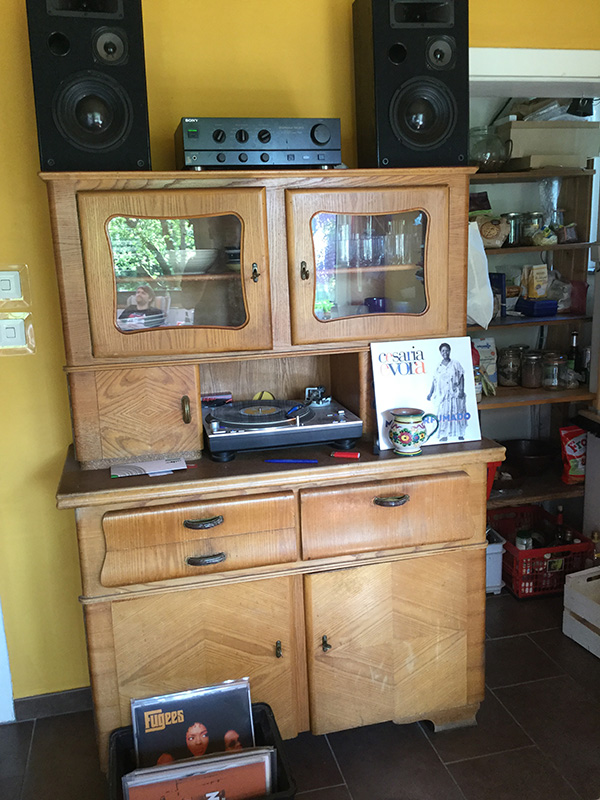
I recently visited a friend — Nadia. She is a music lover, and her vinyl-based rig, consisting of some vintage components, is located in the kitchen. Unlike me, she listens to music while she is cooking, doing something else in the adjacent room, or simply relaxing on the veranda. In contrast, at my place I always listen intently and in front of the audio system. Nevertheless, I really enjoyed the evening we spent on the veranda, chatting about things, drinking and laughing with a couple of friends.
Although her system doesn’t reproduce the finest nuances and the records being played were far from perfect, the music coming from the kitchen was full of life and complemented our evening with mood-enhancing vibes. Some days later, during a phone call, I mentioned that her choice of music was perfect and that I especially liked one LP featuring dub covers of Pink Floyd’s The Dark Side of the Moon. She was pleased, but what I didn’t expect was that a few days later I would receive a copy of the same album, called Dub Side of the Moon.
Though I liked the music as background, I generally don’t listen to popular music intently. Sonically, this LP is also a typically compressed studio recording that my Audio Note system rendered almost unlistenable. This whole thing bothered me because I wasn’t sure whether I should give her honest feedback if she asked for it or not. Of course, I wouldn’t lie to her, and if she asks, I will have to tell her the truth: I listen almost exclusively to jazz and classical music from a very limited number of particular labels. I hope she will understand.
This experience made me realise how far I have moved away from the norm and how large the gap is between an audiophile, as I consider myself to be, and a music lover.

Eventually, I became aware that being an audiophile is both a curse and a blessing at the same time. It is a curse because record quality turns out to be a major factor in achieving satisfaction; therefore, the range of recordings that fulfill this criterion becomes severely reduced. It is a blessing because the effect of the music, however limited in scope, becomes much more profound on a psychological and even biological level. I would say that the record quality is king — it should be natural to really enjoy it in the transcendent audiophile way I am accustomed to.
Apart from the attention paid to recording quality, another thing that sets an audiophile apart from a music lover is the special relationship with the equipment. Unlike the casual music lover, an audiophile strives for ever better reproduction, which usually means that the hardware and the program material are of equal importance. In the end, it is the hardware that unlocks the program and allows one to appreciate not only the music itself, but also its flow, the timbres, the reverberant envelope of the space, and the subtle interplay between the acoustics of the venue and the artist’s interpretation.
I also think that one shouldn’t fix one’s attention on the music itself, but rather let it unfold naturally and concentrate on something else. For me, it is the tone of the instrument being played and the acoustics of the space that allow me to sink into the performance and be carried away by the flow of the music. As it turns out, the tone — the sound of the instrument itself — can also be the driving force behind the music. In the liner notes to his ECM release End to End, the double bassist Barre Phillips is quoted as saying that what truly keeps him going is the sound:
It took four or five years until I discovered what it really was that got me going. I mean precisely what it was. And that was: sound. The sound of the bass. I can get in trance with that. And I have learned since how to do that. It’s like yogic exercise in a sense. And when I get in trance the stuff starts coming out.
Barre Phillips
We audiophiles listen not only to music, but also to sound, and I consider both equally important. Therefore, I can’t understand people using the word “audiophile” in a pejorative sense, as a reference to a person who is preoccupied with sound instead of music. Sound is universal; it can be a deep, therapeutic sound, the sound of nature, of birds and streams, or of pouring rain.
Now I might sound like a self-complacent nerd who pretends to have already climbed the audiophile Olympus, but I have to tell you, that I have gone through moments of desperation — moments bitter with resignation and loss of faith — and I struggled to get where I am today. Somehow, with persistence and a bit of luck, I managed to get through. It wasn’t long ago that I thought I should give up and dedicate my energy to something more sensible than chasing the elusive real sound. The thing is that humans are insatiable beings, and once one has a glimpse of what is possible, one always wants more.
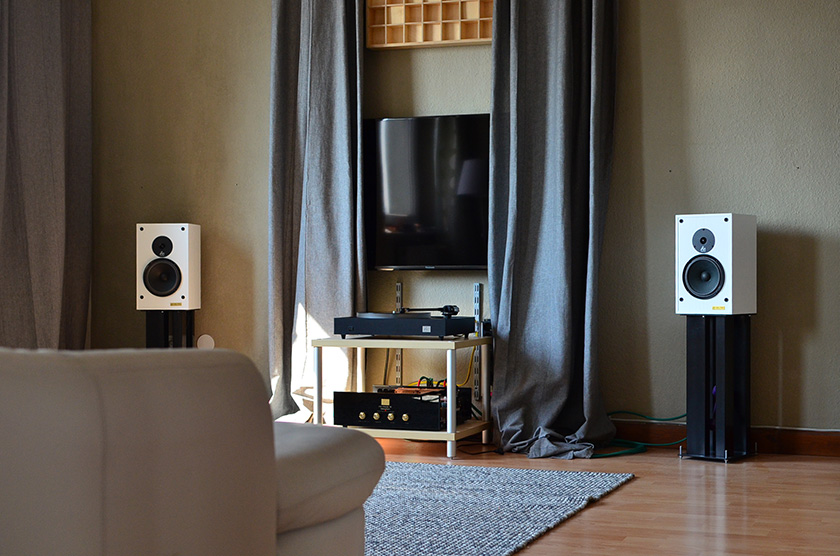
I went through an endless period of adjustments and obsession with the smallest details, which threatened to become overwhelming because of their significant impact on the quality of reproduction. I had to decide whether the spikes should be secured to the speaker stand plates with nuts or not, or whether the top plate should use three instead of four spikes to couple with the speaker, for example. But then the questions arose: how should I listen and what should I listen for? Had the sonic contrast between these two records increased or diminished? Had the specific sonic signature I heard across different records, contributed by the stands’ own resonant behaviour, disappeared or not? And so on. One can really go crazy under the weight of all these questions, so I struggled and spent months practising judgement while trying to get the maximum out of the system.
I often got tired and frustrated, reverting the settings I had made the night before and starting from scratch. Again, I would reach what seemed like a pinnacle, only to realise shortly afterwards that it was another succession of wrong decisions that had brought me there. At some point, I thought I was going crazy. It couldn’t be so bad — tweaking, reverting, adjusting, doing everything except enjoying the music.
Although I have never been so close to the real thing, I started to think that, even though I may not like it, groove modulations are nothing more than the mechanical equivalent of electrical signals. Yes, they might carry the emotional charge of the performance, but speaking of authenticity is pointless. Our minds adjust differently when we attend a live performance compared with when we sit in front of an audio system. We should stop deluding ourselves that we are part of the audience in a concert hall and face the truth: whatever we are doing at home in front of the audio system, it is something very different from attending a concert or encountering live music on the street.
All these thoughts didn’t make my life easier, but somehow they helped me become more grounded and cleared the way forward. The enlightenment came with the idea that we have to forget about the concept of searching for deficiencies in reproduction, because if we search, we will find some. The only thing we should be interested in is pleasure — the pleasure of listening to music. Is it there or not? That is the question. As Sigmund Freud pointed out long ago, the pleasure principle is what drives us: the seeking of pleasure and the avoidance of pain in order to satisfy biological and psychological needs. Under no circumstances should listening to music cause pain. This is counterintuitive and unnatural to human nature, but it is also something we may forget during critical listening.
I felt that instead of looking for deficiencies, I should direct all my attention towards determining whether pleasure exists or not, and, if it does, to what extent. It is far more rewarding and calming to search for perfection rather than imperfection. It is a mindset.

I can tell you that after I started applying this principle, I revisited many decisions I had made in the past, and the fruits of this process are already ripening. I am listening to music again, and I enjoy it immensely.
Thank you for stopping by, and happy listening!
What had happened to the Micoblocks Dimitar?, how do they compare to the AX?
Sorry for the late reaction Bram, I hope my Audio Note AX-Two loudspeakers review answers your question.
Yes it did Dimitar, and what about the single point Fostex?, how do they compare when you listen back to them?
Is timbre winning from imaging?
The single-driver back-loaded horns are also very nice speakers, they do excel in low-level detail retrieval and coherency but the fidelity is ruined by the bumps in the frequency response and uneven decay time in the bass region caused by the horn function. I also feel these horns need bigger room than mine, it is better to listen to them from a certain distance that I could not afford in the limited space I inhabit. I already sold them by the way and the new owner is very happy with them. I feel Audio Note AX-Two are better suited for this particular room and I don’t regret departing with the horns.
Understood, i’m listening to backloaded FE83EN in a 40m2 room.
I like the true image of the single point source, and i can live with a weaker bass, though the mid frequencies are smooth, this is a very fine unit, absolute not shouty, playing everything on it, popular and classic, i’m not playing at high levels with a direct coupled 10Watt class A amplifier, just a little loud, voices are very nice and recording spaces are very good to hear.
Hi Bram, I can perfectly understand you because I have similar preferences. It is amazing how a 3″ full range driver can grow out of itself in a well designed back-loaded horn. Are you using a Fostex recommended enclosure or some other one?
Best Regards,
Dimitar
Of audiophiles and music lovers… so true your findings. Very well written. I often drift into music genres just to listen/compare different equipment and forget about my favourite music.
Dimitar, I thought they were Bushhorns but according the original plans Buschhorns have a height of 90 cm, but my BLH’s have a height of 70 cm’s , so i can’t tell you exactly what it is.
They are so small, standing circa 2,5 meters from each other, but the real width they are imaging is more than 6 a 7 meters.
They have a very flat frequencyresponse so you can play them without a correction network.
Hey Bram, many thanks for the info. It might be that your Buschhorns are the first iteration – the MK1 version that has won the annual Visaton loudspeaker competition back in the 1993. They were designed by Dr. med. Andreas Buschhorn to be used with Visaton’s FRS 8 fullrange 3.3″ unit but people found them to work well with Fostex FE83 as well. These back-loaded horn enclosures are exactly 70 cm tall and 27.5 cm deep, here there is a link to the enclosure plan. I may venture to build them one day, I heard only good things about them and I pretty much like your description.
Take care,
Dimitar
Wunderschön!, das sind sie genau!
Danke sehr,
Bram
You are welcome Bram!
Stay safe and healthy,
Dimitar
Something completely different, Have you ever listened to a TDA7297 amp?
Put it on a battery, i did mine on a 19 Ah Exide from my BMW K75.
Replace the ceramic input C’s for the best you can find whatever it cost, for example PIO’s, think at least silver quality.
Ripoff the safety diode, ripoff the blue led, ripoff the 2.200uF cap, play direct on your battery.
Buy your amp on Ebay for 6$ including postage direct in china.
It’s worth the wait for it.
Good for FE83 Bushhorns, good for Tannoy monitorgold 15inch, Kef Cresta2 and many others, google!
Enjoy!