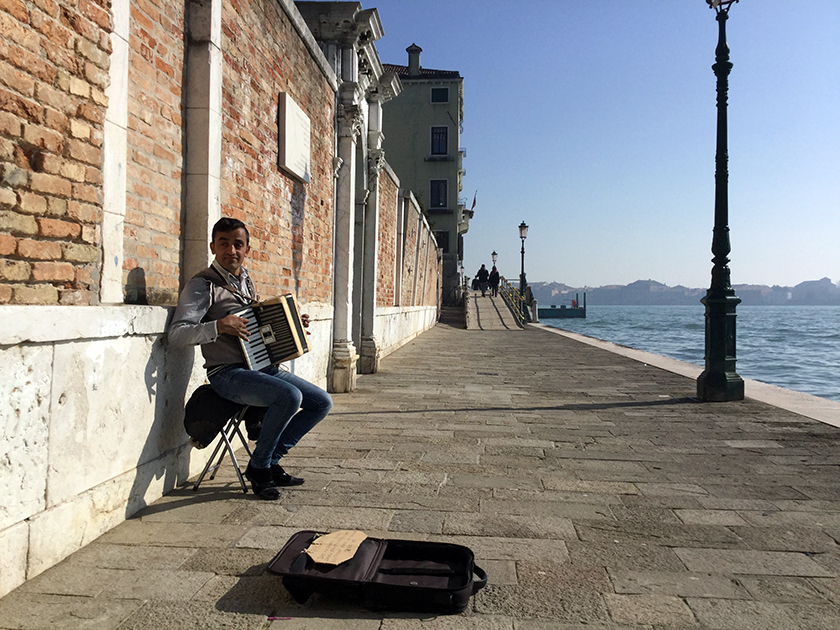
If you are in a desert, having a band performing in front of a wall is better than having a band performing in the open. Space without boundaries is far from ideal. You have no reflected sound waves, and everything is dissipated into open space. Reflections are important, especially the first reflections.
If you have a band performing in a room, you have too many walls and too many reflections. If the room is small, it becomes problematic because the reflected sound waves are too strong and the time they need to reach your ears is too short. You need a room with enough space for reflected waves to propagate properly without dominating the direct sound of the instruments. Otherwise, coloration will occur, and certain frequencies will become exaggerated.
What I want to emphasise here is the fact that the room and its acoustics are among the most important factors in sound reproduction. A budget system in a properly treated room can reproduce audio much more accurately than an expensive system in an unsuitable one.
The advice is simple: put your efforts into creating a space that is friendly to sound propagation rather than spending money on expensive equipment.
The room is difficult to deal with. It is much easier to spend some money on equipment because making decisions there is relatively straightforward. With room acoustics, you need specialised knowledge and experience because every room is different and requires specific treatment.
Another challenge with room treatment is aesthetics and preserving the domestic function of the space. One cannot simply scatter bass traps, diffusers, and acoustic absorbers around the room, as these are usually not the most attractive interior elements. So be careful: the room itself, as a tool for creating comfort, has a significant impact on how reproduced music is perceived.
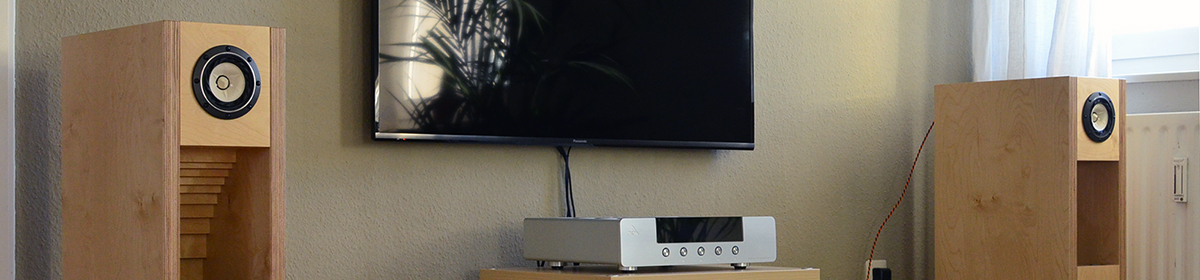
The first thing one should determine in a particular room is the location of standing waves and the frequencies at which they occur. In my room, for example, the unpleasant echoes caused by standing waves occur about half a metre away from the front and rear walls, around the musical note G. As a result, frequencies related to multiples of G are severely amplified in both the time and amplitude domains at these locations.
I discovered this accidentally, simply because I have lived in this apartment for several years. It was an occasional shout in a certain direction and at a certain pitch that revealed the flutter echo.
I tried reducing the echo that appeared near the front wall, where the speakers are located, by applying absorption in the form of a blanket. I first attached it to the front wall, then tried the side wall and even the floor, but there was no noticeable effect. Finally, I attached the blanket to the ceiling — and what a result! The echo nearly disappeared.
As a more aesthetically pleasing solution, I replaced the blanket with a curtain fixed at its four corners with small screws attached to the ceiling. The whole treatment cost me €25 — the price of a pair of cotton curtains from IKEA.
It was not expensive, but since then the listening environment has improved significantly. It is not perfect, though, and some additional diffusion is probably unavoidable.
One should be careful, however, not to overuse absorption. Having some subtle reflections occurring at certain frequencies can actually be better than creating an overly soft and acoustically dead room.
Therefore, I have decided to install some diffusers on the front wall below the ceiling sail, but this requires some additional effort. Absorption is easy — you need only a curtain or a blanket — but a diffuser is made of wood and requires proper construction.
I will keep you informed about my further explorations on this topic, dear fellows.
Cheers, and may the tone be with you!