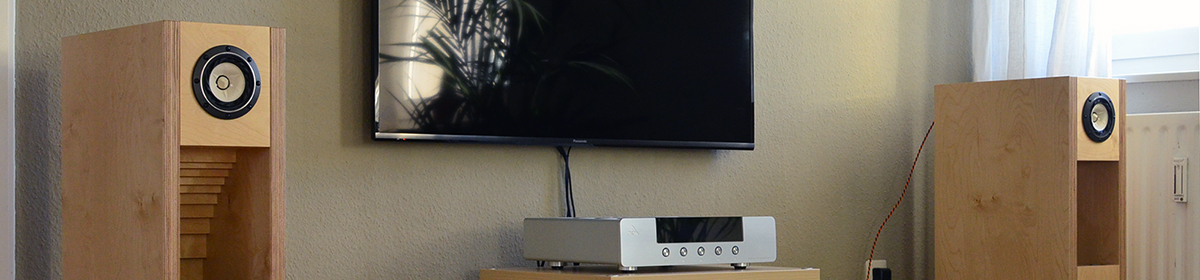

I had a chance to try a new amplifier over the weekend, guys. It was a non-negative-feedback solid-state device in the price range slightly below €3k. I spotted it a long time ago after reading a rather positive review in a French magazine. I contacted the brand owner and asked if I could have one for a week to check how it would perform against my current tube amplifier. Although it was twice as expensive as my current one, I was quite sceptical about the transistor contender being able to outperform my tube Line Magnetic LM-211IA amp.
The owner’s answer was positive, and shortly after, eager to refute my suspicions, I received a nicely packed unit. The transition from hopeful expectations to bitter disappointment took about a second, guys, so my intention to write a review of a component I don’t actually own failed.
I don’t feel like writing about components that fail to deliver according to my expectations and criteria. I also don’t want to write about components that I would not recommend, and this is my right as a free blogger. That is why I will not mention the manufacturer of this device, who was kind enough to give me the opportunity to test his product.
In the end, this case can be viewed from a broader perspective — tube versus transistor amplifiers rather than brand X versus brand Y — because it confirms my previous experiences with solid-state amps. So I will not write a review this time; instead, I will try to briefly describe this traumatic experience.
The first thing I noticed after letting the music flow through it was a kind of low-level noise that smeared details and filled the moments of silence that the musical experience is built upon. It was not a noise that you could actually hear, like hiss or something similar, but rather a lack of transparency and space that I have become so accustomed to.
I am not sure whether it is in any way connected to the signal-to-noise ratio parameter, and I have no idea how this amplifier measures in that regard, but I figured that with such a sonic signature, listening fatigue would set in pretty quickly — not to mention that the listening experience itself was simply not enjoyable. Detail resolution was suffering as well; transient response and microdynamic rendering were nothing more than mediocre.
After a short while, I realised that the worst thing was the lack of tone colours. What I mean is that all the instruments sounded as if they were made from the same artificial material, so that the slap of a double bass string or the strike of a piano key did not in any way suggest the presence of a real wooden instrument being played. The same applied to voices, which sounded somehow synthesised and processed, lacking warmth and humanity.
This difference struck me deeply because I switched to tubes a year ago and had grown out of the habit of enjoying such an unrealistic presentation.
Fausto Mesolella’s Live ad Alcatraz is a revelation for acoustic guitar lovers. It captures an abundance of tone colour and timbre that resonates within the stone walls of the old prison, creating a perfect harmony that can transport you directly to heaven. Another example is Wolfert Brederode Trio’s Black Ice album, which features some of the best-recorded cymbals I have ever heard. One can feel the impact of the wooden stick striking the metal and the propagation of the surrounding sound waves.
Both records are characterised by enormous dynamic range, a strong sense of space, low-level detail, and transparency, but none of this was properly conveyed.
In the end, my illusion that a €2.7k solid-state amplifier could match the performance of the LM-211IA was shattered, leaving me with a bitter taste. On the other hand, my belief that the LM-211IA is an outstanding amplifier was further confirmed.
I couldn’t help but think that I’d better stay in the tube camp.