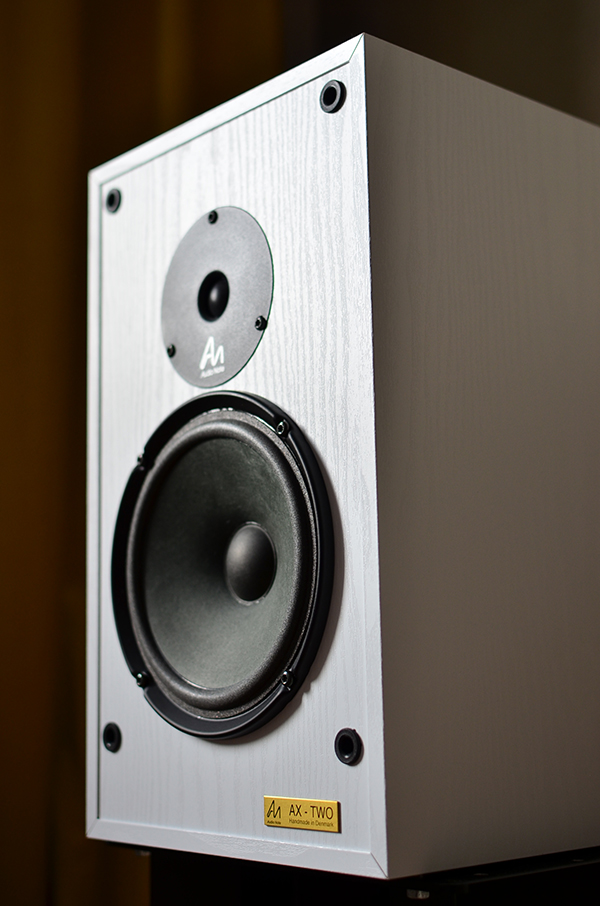
I have to confess that initially I was impressed neither by their appearance nor by their sound. It was a year ago that I climbed the stairs to my apartment carrying the 15 kg box that Andy Whittle handed me after a short stop at my place on his way to Copenhagen. “These are your new speakers; give them some time to properly break in,” were his words.
At the time they arrived, I was experimenting with the Micro Block DIY speakers, and I really thought Whittle’s creations would have a hard time competing with the Timmermanns’. My expectations were confirmed on the first listen. They were a disappointment and didn’t come anywhere near the Micro Block’s dynamics, bass extension, and sense of gravity. I didn’t want to waste my time with them but rather continue experimenting with damping, port, and crossover adjustments on the Micro Block.
So after a short listening session, I put them back in their box, sealed it with tape, and called it a day. I realized that I didn’t want to spend dozens of hours in front of these unimpressive speakers, expecting them to improve with time, while I had such an interesting project going on.
I wrote to Peter that I am done with the speakers and I actually don’t like them:
I gave the AX-Two a try yesterday, but got rather unsatisfactory results. They sound pretty unspectacular and cheap, a rather big step backwards compared to my current speakers. They might improve after some more hours of use, but I doubt that they will ever reach the level of performance of the Micro Block MK2.
But however impressive the Micro Block sounded initially, I eventually grew dissatisfied with them. There was a sort of glare in the midrange region that I was not able to tame. Another thing that bothered me was the inconsistency in detail retrieval across the frequency spectrum. The bass lacked resolution and sounded somewhat one-note; they were simply putting some sort of signature on the music that constantly drew my attention.
And I confess that I made a few mistakes by deviating from the original design proposed by Bernd Timmermanns. The first was my choice of enclosure material: plywood instead of MDF. My advice to anyone who decides to build the Micro Block is to stay true to the original design and use MDF. It might sound counterintuitive, but in certain cases MDF or even chipboard is preferable to plywood.
I had a conversation on that topic with loudspeaker designer David Haigner, and his opinion is that, especially because of variations in wood quality, plywood is an ever-changing target with strong and narrow resonances that is harder to “tune” than the more highly damped MDF. He also considers that the popularity of plywood within DIY circles is due to the fact that it provides a finished surface requiring little effort to look good. So I am inclined to think that the aforementioned coloration could also be attributed to the choice of enclosure material. This sort of glare effect became even more pronounced after I decided to glue the internal braces together. My advice is: try not to be smarter than the designer, but keep to the original concept.
Fast forward – few months later
Eventually, I reached a state of burnout where I was no longer listening to music but to defects in the reproduction, and that was the point when I had no other choice but to give the AX-Two a second chance. And this time it worked out. I guess I had to go through this struggle in order to appreciate the innate musicality of the AX-Two. In fact, they felt like a breeze, stepping out of the way and not drawing attention to themselves; they simply allowed me to appreciate music. I had no wish to fiddle with them at all. Not that they were perfect, but they simply let the music be, without putting a stamp on it. I felt sorry for my rash conclusions, and I couldn’t believe I had judged them so badly at the beginning.
Although they still lacked the sense of weight and sheer slam of the Micro Block, they sounded extremely coherent, almost like a single-driver speaker. I also noticed the very well-defined soundstage projected naturally behind the speakers. I learned an important lesson this time, one which Peter summarized with the following words:
Listening is a learning process. Often, what impresses initially is not necessarily right, so there is no need for excuses. I am happy you reached the right conclusion eventually. Your journey should be written down in your blog as well, as it is a useful reminder to readers that first impressions are not always valid in the longer term.
Peter Qvortrup
With careful setup and more run-in time behind them, the AX-Two inevitably started to impress. What I discovered, and would like to share, is that the stand itself plays a key role in how extended a stand-mounted speaker will sound. I use heavy steel stands — Audio Note AN-K — that are not welded but assembled. The top and bottom plates, made of quite thick steel, are attached to the hollow legs with bolts. The alloy from which the legs are made is quite inert and is the result of extensive experimentation. I was caught by surprise when I knocked on them with a fingernail and heard no ringing whatsoever, but rather a dull sound that one would not usually associate with metal.
I use them empty, coupled to the floor and to the speakers respectively with the supplied spike sets. I also tried Blu Tack and other putty materials between the stands and the speakers, but nothing came close to the dedicated spikes provided with the stands in terms of bass extension, clarity, and the natural buildup of harmonic overtones. The role of the spikes is to allow the stands to couple on one side to the floor and on the other to the speaker, serving as a mediator and channeling energy transfer between them.
Using Blu Tack seems to impede this energy transfer by effectively decoupling the speaker from the floor, which, in my opinion, negatively affects the sense of realism. This effect is especially noticeable when natural recordings with plenty of spatial cues are reproduced. In the end, I think the way we set up our speakers is part of the creative process that most of us enjoy and see as an opportunity to express ourselves and our understanding of what good audio reproduction actually is. Therefore, I don’t want to claim that one method is better than another, but rather encourage experimentation in case you still feel there is potential for improvement.
After a careful setup, what impresses me the most is how transparent and open they sound while maintaining considerable bass extension and bloom. It is the kind of transparency one usually associates with open-baffle speakers, combined with the full low-frequency extension of a ported enclosure. This is really the key: a well-balanced mixture of the best of both worlds, and I couldn’t stop wondering how this was possible. On the one hand, it is the woofer itself — the venerable 6.5″ Vifa C17, featuring a curvilinear paper cone, stamped steel basket, and foam surround. This woofer has appeared in a range of commercially available loudspeakers during the 1980s and 1990s, most notably in the highly regarded Dali 104 loudspeakers. In fact, these very same drivers were used in speakers that preceded the Living Voice Auditorium series of floorstanders, which started in the early 1990s. It is therefore no surprise that this peculiar-looking woofer, with its stamped metal chassis and short waveguide extrusion, is also found in Audio Note’s AX-Two stand-mounted loudspeakers. On the other hand, it is the particular implementation that I find very interesting and deserving of a closer look.
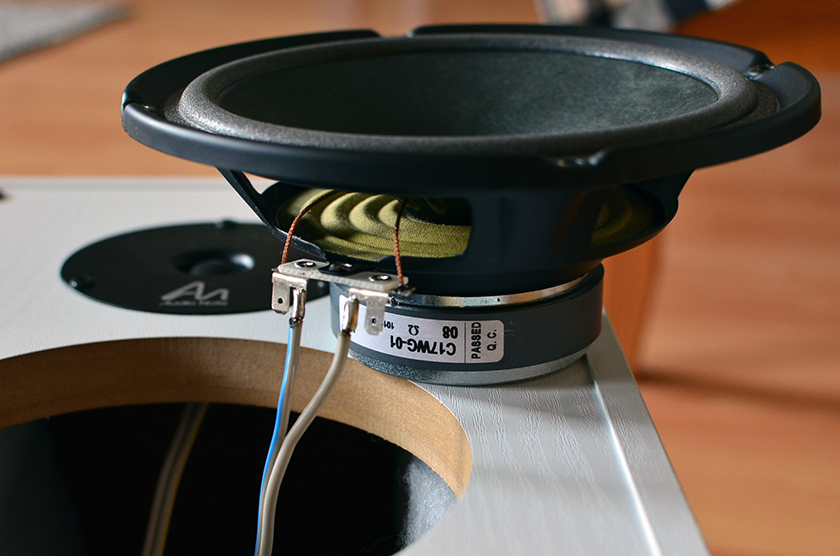
Trying to figure out the secret behind this, I decided to check whether the boxes were acoustically sealed. I blew through the port and noticed that air was escaping all around the woofer’s flange. As it turned out, there was no gasket between the woofer and the baffle, meaning that the enclosure was “leaky.” According to theory, however, a ported enclosure should be airtight in order to function properly. I realized that the AX-Two behaves partly as a bass-reflex enclosure and partly as an aperiodic box, and this must be the main reason for the elegant combination of qualities it exhibits.
Out of curiosity, and to confirm my assumption, I decided to check how the speakers would behave if it were properly sealed. I used the self-adhesive foam gasket tape I had at hand to seal the woofer openings, and, as you might guess, the magic was gone. Deprived of its aperiodic behavior, the speaker sounded, let me say, quite typical. For me, it was clear: as with everything Audio Note, we are dealing with a rather unorthodox and carefully considered design that obviously leaves no room for dogma.
By carefully combining two distinct approaches to speaker design, Audio Note has achieved what I perceive as an extremely transparent, dynamic, and extended sound. The “leaky” enclosure seems to provide the Vifa C17 with ideal conditions to perform at its best while also reducing the impedance peak at the resonant frequency, which makes it more amplifier-friendly.
Construction
The enclosure itself is made of 18 mm thick MDF finished in wood-grain vinyl and uses a single sheet of 2 cm thick low-density polyester felt covering the back and sides. The side, top, and bottom panels are rabbeted so that they wrap around the front and back panels by half of their thickness. There is no bracing of any kind.
With a net volume of 11.5 liters and a reflex-loading port measuring 3 cm in diameter and 10 cm in length, the enclosure is tuned to around a 40 Hz resonant frequency, which lies well below the speaker’s low-frequency cutoff of 55 Hz. This is quite unusual, considering that the vast majority of compact bass-reflex loudspeakers, including the Micro Block, have their ported enclosures tuned at or slightly above the cutoff frequency.
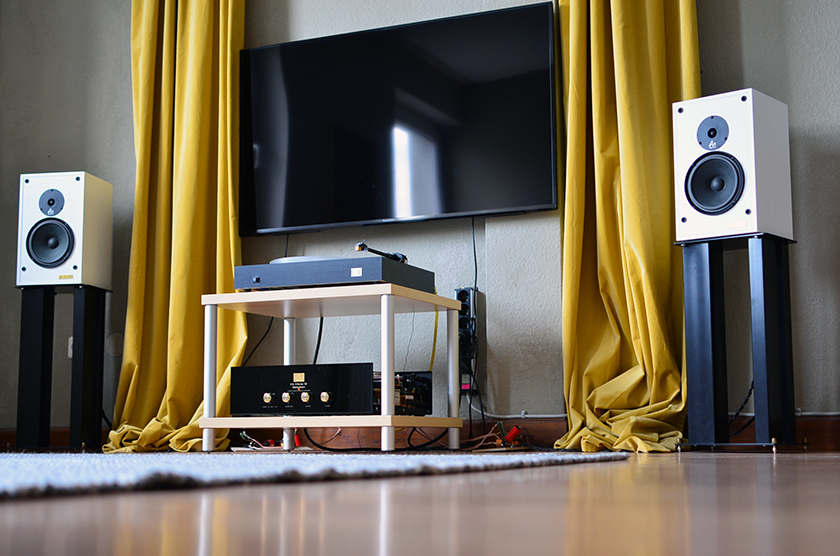
The fact is that the AX-Two, as well as any other Audio Note speaker, is designed to work near room boundaries; therefore, the additional bass reinforcement from nearby walls is part of the design calculation. I can attest that this concept works. Placed 15 cm from the wall and 2.40 meters apart, these speakers produce an extremely clean and tuneful bass that makes the Micro Block’s bass performance sound somewhat one-note and lacking in resolution.
True, the enclosure’s net volume and the woofer’s effective radiating area are other factors one has to consider, and they are all in favor of the AX-Two. However, here I am talking about a substantial difference in quality that I believe reflects the underlying design principles.
Speaking about the bass performance, I should not forget to mention the tweeter — the 3/4″ silk dome Vifa D19 — which is also a long-time favorite with a long production history. I can’t help but think that the perfect coherence I experience has something to do with the integration of both units within the crossover design. Taking a look at the circuit board, I can see a neatly conceived dividing network featuring a second-order 12 dB/octave low-pass filter and a third-order 18 dB/octave high-pass filter. It is a straightforward design: no Zobel network or anything of that sort, with six elements in total (actually seven, because due to space limitations two parallel-connected capacitors are used instead of one).
What impresses me most is the placement of the attenuation resistor in the high-pass section, which is positioned at the very beginning, before the filter group. I have never seen Bernd do this; in all of his projects, the resistor or voltage divider is always the last element placed after the filter group and just before the tweeter. Judging by how seamless the integration feels, I think placing the resistor at the very beginning is intended to achieve maximum phase linearity. I am impressed.
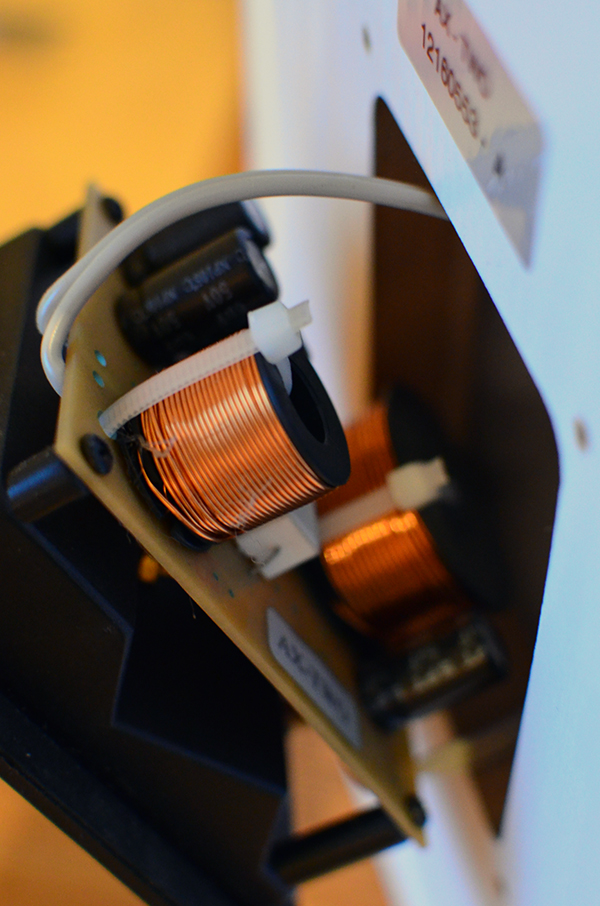
Interestingly enough, the Micro Block dividing network uses the same combination of second-order low-pass and third-order high-pass filters, but while Micro Block uses 12 elements to achieve this (without counting the elements in the recommended impedance linearization network), the AX-Two, as I mentioned, needs only six. Where Micro Block resorts to a Zobel network to electrically address phase-angle anomalies, AX-Two resorts to mechanical means through a judicious mix of aperiodic and bass-reflex driver loading.
The pursuit of simplicity by keeping the parts count low as a way to achieve perfection is reflected in the entire philosophy of the British company and can be traced across its whole product range. It is something that gives the brand consistency and a characteristic signature. As a user, I can attest that the “keep it simple but not simpler” principle works here. The AX-Two wins against the Micro Block in all disciplines that are essential for communicating the emotional impact, artistic message, and aesthetic value of a record.
My amazement continues to grow because, despite the use of the cheapest electrolytic capacitors, a ferrite-core inductor, and a ceramic resistor, these speakers exhibit such coherence and dynamic prowess. I can’t help wondering: what if the crossover boards were removed from the enclosures, away from the constantly changing pressure, relentlessly pounding airwaves, and mechanical vibrations? What if higher-quality parts were used — foil capacitors instead of electrolytics, an air-core inductor instead of a ferrite-core one, and a metal-oxide resistor instead of a ceramic one? What if…
I simply cannot stop myself. I know it is not a reviewer’s job to poke his nose into such matters, and especially not to modify a component sent for review. It is something one should never do. Yet I can’t stop myself; it is that passion that burns inside and tells me these speakers have enormous potential waiting to be released. I ought to give them what they deserve, and in return they might allow me a glimpse of heaven.
Bringing the crossovers out
As I already said, I couldn’t resist the temptation to try the sonic outcome of one simple modification: bringing the existing crossover boards out of the enclosures. Generally speaking, placing the crossover board inside the enclosure is a serious compromise dictated by production costs and convenience considerations.
For this experiment, I decided to use the same Kimber 4PR bi-wired set of cables that I had already used for a week. What I did was to unsolder the boards from the connecting cables, then solder the driver’s cables directly to the binding posts. After that, I soldered new cables to the input and output of the crossover boards, while maintaining the bi-wired configuration and ensuring correct polarity. The only difference now was that the crossover boards were outside the enclosures, closer to the amplifier and farther away from the speakers.
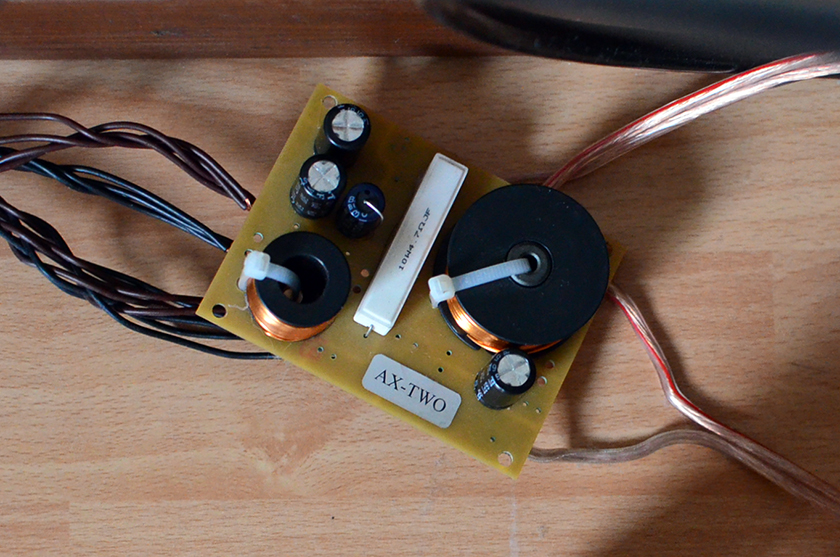
I remember the first listen with the outboard crossovers as if it was yesterday. It was the Chet Baker & Paul Bley collaboration Diane (LP, SteepleChase SCS 1207). I was simply shocked by the effect of this relatively simple tweak. Baker’s trumpet was shimmering in the air with a real brassy sheen, while the deep bass notes produced by Bley’s piano, rich and dense with harmonics, were unfolding in the surrounding space — an electrifying, goose-bump-inducing experience. I instantly noticed the gain in clarity and immediacy; it was simply startling. I couldn’t stop listening until the needle hit the lead-out groove; it was mesmerizing. I was so excited that a few hours later I wrote an email to my friend Oscar telling him about the outcome of the experiment:
I just want to tell you that I brought the crossovers out of the enclosures. This was the only change I made, using the same Kimber double-run cable I had been using lately. I am speechless. These speakers are now performing at a level I didn’t think was possible — amazing stuff. It turns out that something I suspected a long time ago is true: bringing the crossovers out produces a massive improvement, greater than simply changing capacitors or wires.
Getting rid of the printed boards
Once you get on that road, it is hard to stop. The gain in purity and immediacy is addictive; it brings you closer to the artist’s intentions. The interaction between both musicians became so palpable and transparent that one could sense every hesitation they encountered, every uncertainty, every shade of expression.
After a few weeks of enjoyment, I decided to move the crossover elements out of the original boards and use point-to-point soldering to eliminate the printed circuit paths. I kept the original coils and one of the capacitors, but replaced the remaining components with inexpensive film capacitors I had at hand. The ceramic resistor was replaced with a metal-oxide equivalent.
I was expecting some improvement, but this time the effect was even greater than anticipated. The music seemed to flow unrestrained, as if liberated; it was like a dam had burst open and the stream was rushing forward with all its energy. The last obstacle was out of the way. Believe it or not, I had to reduce the volume because I perceived it as having increased. I cannot explain why this happened or exactly how eliminating the printed board affects the perceived loudness, but I have the feeling that the speakers are now slightly more efficient.
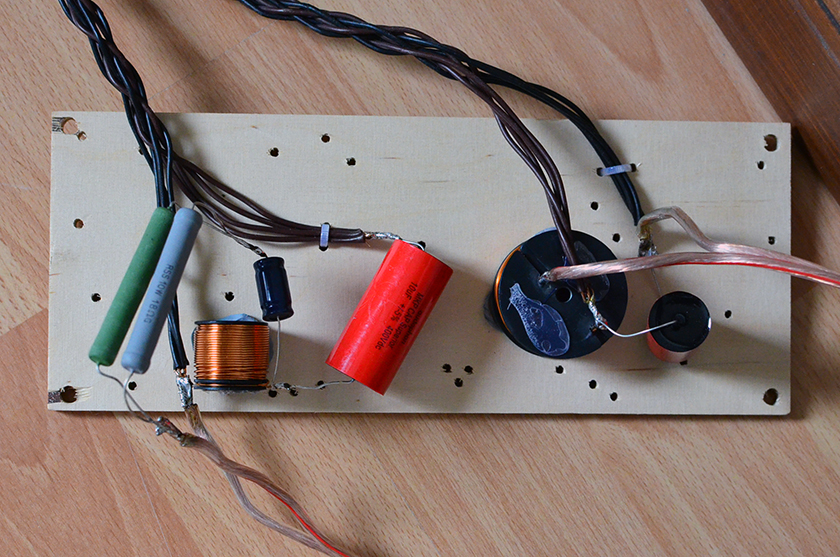
Honestly the AX-Two outboard crossover project has exceeded all my expectations. I have been enjoying these crossovers for a few weeks now, and they give me a glimpse of what the AX-Two are truly capable of. I am definitely going to continue this experiment and, as a next step, plan to replace the ferrite-core coil and the last electrolytic capacitor. Afterwards, I may try some higher-quality capacitors and cabling, finalize the layout, and replace the provisional boards with dedicated ones.
Listening impressions
Balanced is the most accurate adjective I can come up with when trying to describe the Audio Note AX-Two. These speakers do not favor any particular genre but perform equally well with acoustic or electronic music, vocal or instrumental recordings, and natural or studio productions.
Listening to Jan Garbarek’s classic I Took Up the Runes (LP, ECM 1419), I am taken on a journey through fantastic landscapes created by Bugge Wesseltoft’s synthesizer, with peaks and valleys traversed by Eberhard Weber’s unexpected and bold bass lines, and rays of sunlight peeking through the clouds radiating from Garbarek’s saxophone. The sound is spacious and densely saturated, very solid and liquid at the same time.
To check how the AX-Two handle the human vocal range, I give Kenny Wheeler’s suite Mirrors (LP, Gearbox GB1513) a spin. Featuring Norma Winstone backed by the London Vocal Project, this is a contemporary recording made in the best analog traditions, using Studer tape machines, a vintage Haeco Scully cutting lathe with Westrex heads, and Audio Note monitoring equipment.
Norma’s voice, whether solo or backed by the 24-voice chorus, is as vividly present as I have ever heard from a record. There is an unmistakable warmth radiating from a living performance that only the best recordings played under the best conditions can deliver. I am enthralled; it is so charming and comforting to listen to this record, and it fully demonstrates what properly made vinyl has to offer.
Conclusion
The AX-Two are exceptional speakers. Especially with the outboard crossovers, they deliver performance on par with some of the best stand-mounted transducers I have ever encountered, at a fraction of their price. Their relatively high sensitivity of 90 dB (2.83 V, 1 m), benign phase-angle characteristics, and 6-ohm impedance make them a perfect partner for low-power tube amplifiers. Featuring a pair of posts per speaker driver, the terminal plate allows for bi-wiring, which I find beneficial.
When bi-wired, these speakers maintain the seamless integration of both driver units while bringing additional clarity and composure to the presentation. Power handling is very good, and there is plenty of headroom before they begin to compress dynamics — something I have never experienced. They are capable of playing very loudly while keeping the whole picture intact. They also maintain their balance at very low listening levels, which makes them a perfect companion for late-night listening when the neighbors are asleep.
All in all, this is an excellent speaker that has become my reference.
Thank you for stopping by, and
Happy New Year!
Hi
I am listening to my AX Two as i read your blog. Fantastic results you got there! Have you changed the remaining caps and which ones do you use? I must try that mod! Thanks for a very interesting read!😃
Hi Fredrik,
Thanks, I am glad you liked the read and got inspired!
You should definitely try the outboard crossovers for they will give you an idea of what AX-Two are really capable of. Better keep the original crossover boards intact and build new ones from scratch. This way you will be able to restore the speakers to the original state if you decide to sell them later, which I really doubt. The parts used in the original crossovers are of basic quality and it doesn’t make sense to reuse them. Here is the schematic of the original network you can base your new build on. You can start with any budget foil capacitors first and later on switch to some more expensive ones. I usually use MKP foil capacitors from Audaphon during the prototyping stage, but for the final build I would go for Mundorf MCap Supreme. Two of the capacitors used in the original boards have values of 6µF and 12µF that are not standard, but you can use 5.6µF and 10µF instead. This will shift the tonal balance slightly, but later on you can always add some small caps in parallel to achieve the precise values. The 1.33mH coil in the low pass-filter has also non-standard value, but you can use 1.5mH one (any air core coil with wire diameter between 1.2mm and 1.4mm would do) and unwind few turns until it reaches an inductance value of around 1.35mH. For this you will need an LCR meter that doesn’t need to be expensive. Another alternative is to use two standard 0.68mH coils connected in series (something like this), which will bring the total inductance to 1.36mH and sounds pretty good. The 0.33mH coil in the high-pass filter is made out of 0.7mm wire and has a standard value. Hope this helps.
Regards,
Dimitar
The original XO shows 4 caps, yet your XO shows 3. Can you explain? Were two of these caps on the original XO summed to form one of the values on your hand-drawn XO? Please advise.
Thanks,
Steven
Yes Steven, two connected in parallel 6µF capacitors are used in the original crossover to form the single 12µF cap shown on the schematic.
Cheers,
Dimitar
Hi Dimitar,
I am most impressed with your Blog and I now own a nice pair of AX Twos. Their sound is wonderful and most af all coherent. The best result I surprisingly achieved with a cheap mm pick-up (Audio Technica ATVM 95-E) on my rebuild Lenco L75, which seems to strenghten the coherency even further (I also own a Rega Apheta and a DL-103, but the Audio Technica is more to my liking). My problem arose as I bought a cheap pair of Dali 104, took them apart, braced the inside and damped them with felt and bitumen. I brought the XO out and raised the speaker 12 cm. They sound different than the AX Two (of course!) even w/ the same drivers and a similar (?)tweeter. But they sound great too and have some of the same qualities (probably due to the Vifa c17). They have more space and presence than the AX Two. But, but, but… They lack the coherency and therefor I can´t forget the Audio Notes. Do you have any idea how to make the Dalis more coherent? Is the cabinet too large? I know, that you can´t turn a speaker into something it is not, but still, it´s a fun project and I´m curious if you have anything to say to this.
Hi Peter,
Thank you! Sounds like a very interesting project you ventured into. As I understand, you have increased the speaker’s volume by making it taller. This I think will alter the group delay response and should be addressed in the crossover. You can play around with the values of components in some systematic way but I doubt this will work out. You can also decrease the speaker volume to the initial state by placing some bags with sand inside the enclosure. This will tell you if the deterioration in coherency you have noticed is due to the increased volume or the reason is something else.
Generally I would not expect a 2.5-way speaker to sound as coherent as a 2-way speaker; the same way I would not expect a 2-way speaker to sound as coherent as a single driver speaker. That’s the reason why Audio Note is not offering a 3-way speaker – because to integrate 3 drivers seamlessly is an impossible task. What they have accomplished with AX-Two in terms of coherency is nothing short of amazing, so no wonder that Dali 104 does not sound as integrated.
Have you used the PTP kit to rebuild the Lenco or you keep the original top plate? I just recently stumbled upon Clinamen’s hot-rodded Lenco and I am stunned, I think this might easily be the ultimate Lenco.
Cheers,
Dimitar
Hello,
great review! So great that I grabbed a couple of these speakers and they are really something special.
One question: in your tests, why is the optimal distance from the back wall?
Thank you!
Hello Sergio,
Thanks for the kind words. I am glad you like these speakers, they are fantastic. I keep them really close to the wall behind – 3 to 5 centimetres away, wide apart and aimed at the listening position.
Best Regards,
Dimitar
Thank you! Andy Whittle, the designer, wrote me suggesting to keep like 20 cm from behind wall and toed in about 20 degrees. Going to experiment a little:). I guess everything is very room depending. I am going to experiment a little and post here my findings!
Best regards
Sergio
Thank you too! I am glad you are willing to share your experience with us. Sure, speaker positioning depends on the room acoustics and the associated equipment, but it is also a matter of personal preference and taste. At the beginning I used to keep them more then 10 centimetres away from the wall but with the time my tastes evolved and today I prefer them really close to the wall behind. I am sure they might sound quite appealing when placed further away from the wall but in the long run I prefer them closer to it.
Best regards,
Dimitar
Hello Dimitar,
I really understand your point. Actually close to the wall they do something really well. Can I ask a couple of questions?
When you measure 3-5 cm from the wall you measure from the corner of the speaker nearest to the wall or from the center of the rear of the speaker?
And finally, the distance between speakers is equal to the one from the listening point?
Really thank you!
Sergio
Hello Sergio,
yes, I mean the distance between the nearest corner and the wall, currently it measures 4.5 centimetres. My room is not well suited for equilateral triangle arrangement, so the distance between the speakers is roughly 3 metres while the distance from each speaker to the listening position is about 4.5 meters. It is still a very engaging presentation that works well for me.
Happy listening,
Dimitar
Hi
I’ve read your articles with interest numerous times.
In the meantime having upgraded my AX TWO’s with better cabling and a small adjuster cap parallel with the 2 tweter caps.
The idea of removing their x-overs from their cabs intrigue me.
I have later learned what initially appeared to be a step forward with prolonged listening proved not to be.
Does the same go for the sole removal of the TWO’s crossovers?
If this also belong to your rejected suggestions.
I won’t bother with “all” the hassle😄
Have a nice day
Henrik
Hi Henrik,
Glad to hear you are enjoying your AX-Two’s. Bringing the crossovers out of the speaker’s enclosure is a great way to improve their performance and there is no going back. Rebuilding them with better components and point-to-point wiring will boost the performance even further. I don’t know where you have learnt that with prolonged listening the improvement proved not to be an improvement, but it is definitely not on this website because I have never mentioned it. What turned out not to be an improvement in the long run was the series crossover version I developed as an alternative to the original parallel one. So stick to the original circuit if you decide to rebuild.
Best Regards,
Dimitar
Hi Dimitar
Thanks for your kind reply.
I’ve written this the other day.
But something apparently went wrong, and my initial inquiry was posted again twice. Sorry for that.
– What I’d like to ask you is; did you substitute the original inductors too?
Someone “in the know” told to me NOT to touch the inductors, when I upgraded a pair of Type K’s a couple of years ago.
So I only did the capacitors then.
(Their intern cables had already been changed to SPx long long time ago)
If I really really like my AX TWO’s after their Xovers have been brought out.
I might do the same to my K’s xovers -although it’ll take some more, not being as easily removed as the AX’s.
Thanks again for taking your time to answer, much appreciated!
Kind regards
Hans-Henrik
Ooops sorry!
Dear Dimitar
Thanks ever so much for coming back to me, and eventualy correcting my misconceptions.
Must be too long time ago since I read about your different experiments.
A case of false memory on my behalf.
Sorry!
I love my beautiful AX TWO’s dearly for what they bring:
Lightning speed and unparallelled openness – compared to my other AN speakers (upscale K’s and E’s)
So will get cracking shortly.
Can’t wait to hear what it’ll bring
One last thing:
Have you experienced any discrepancies SQ-wise between the factory supplied inductors and your upgraded ones?
(Or did you finally stick to upgrading capacitors only?)
I ask this specifically because someone “in the know” told me NOT to touch/ substitute the original inductors.
Telling me the ones that did. Eventually reverted to the speakers originally delivered inductors.
With my TWO’s already playing rather sublime with my initial upgrades made to them (AN silver internal leads and a very small by pass/ adjuster cap on the D19s caps) I reckon I’ll be in for a treat, once they’re finished!
Thanks again for your kind reply
Hans-Henrik
Hi Hans-Henrik,
no need for apologies. You brought a good point here regarding the inductors and I am glad you asked this question because this is topic often overlooked by DIYers. I must say you are absolutely right, if someone expects just to drop in a replacement coil of the same inductance as the original without paying closer attention to its DC resistance he is up for surprise, the speaker will sound nothing like the original. So the DC resistance of a coil is of crucial importance and we are talking here about resistance value close to a hundredth of an Ohm which is also really hard to measure. For example the original 1.33mH inductor in the low pass filter has DC resistance of approximately 0.50 Ohms and if you substitute it with a coil having DC resistance of let say 0.45 Ohms this will alter the speaker’s performance quite noticeably. One might say it is nothing much to worry about – some 0.05 Ohm of resistance – but seeing it as a percent of the total DC resistance of the coil we are talking about 10% difference from the nominal value and that is a lot. Regarding the DC resistance of the replacement coil one should really stay within the 5% tolerance as a maximum allowed deviation. And even then, small adjustments of the rest of the crossover’s components might be necessary to compensate for that deviation. So yeah, if you are not using the original coils, even if you try to match the DC resistance as closely as possible, it is quite probable that you’ll need to make some additional adjustments in order to match the response of the original.
I must say I have tried dozens of coils having the same inductance but just slightly different DC resistance (this depends on the wire diameter and the geometry – core diameter and winding height) before I have found the right ones, and it was a long process but I can say it was well worth. You can see the coils that I am using here – low pass, high pass Although these coils have DC resistance very close to the original ones I needed to adjust the high-pass crossover section to compensate for the slight deviation of the coil’s DC resistance and to fine tune the speakers’ response to my room. I have upped the attenuation resistor from 4.7 Ohms (original) to 4.8 Ohms and the second high-pass cap from 12μF to 12.47μF in order to compensate for the slight DC resistance deviation of the new coils. Here you can see a pic of the crossover – top view and here the underside where you can see the adjustment resistor and the small .47μF adjuster cap – bottom view. You can see that I have two 10 Ohms resistors in parallel which make for a total of 5 Ohms resistance and then with a third resistor in parallel having a value somewhere between 100 and 150 Ohms one can fine tune the speakers to his own preference. I am using a 120 Ohm adjuster resistor there you can see at the underside. One might think that going from 4.7 Ohms attenuation resistor to 4.8 Ohms is nothing but I can assure you that even smaller increments of the vicinity of 0.05 Ohms have tremendous impact on the speaker’s response and dynamic behavior because it affects not just the twitter attenuation level but the system’s impedance and attenuation curves. All the rest stays as in the original – I am using a 1.8μF in parallel with a 1.5μF cap to get the 3.3μF value in the high-pass section (you can see them next to the big 12μF cap) and a 3.3μF in parallel to a 2.7μF cap to get the 6μF value in the low-pass section. These two caps – the first in the high-pass and the one in the low-pass sections should stay so.
So my advice if you decide to go for external crossovers, which I highly recommend, is to forget about modifying the existing crossovers, but build new ones from scratch. You can keep the original crossovers as a reference and bring them first outside, just in order to assess the negative impact cabinet resonances and air pressure variations have on their performance. Then you can source the necessary parts, build new ones and substitute the originals. You can fine tune the crossovers afterwards by varying the values of the attenuation resistor and the second high-pass cap.
Hope this helps.
Cheers,
Dimitar
Dear Dimitar
Thanks for your kind and thorough reply and explanation.
Very much appreciated!
Sorry for coming back to you so late, due to a rather late summer vacation.
– I’ll take your recommendations in small increments in order better to hear what happens as I go along.
With regard to all the hassle nailing just the right resistor value for the D19 tweeters I’m going to use what AN UK uses for their E, J and K speakers:
A wirewound adjustable resistor.
Found mine at “digikey.com” on line.
(I think they are 10 ohm BROWN colored types – the color will help you to more easily sort out the “right” type for the job – as used by Snell as well)
This type – besides sounding real great – makes you able to fine adjust the value with the utmost precison.
I think I’ ll start out going back an forth setting the resistor value by ear, to see how it correlates to the known value – and the value you mention.
And see what happens.
The adjustability and the fact thar the crossovers are now out of the boxes and readily accessible, will make it a breeze to do so.
Thanks again for taking your time to answer me!
I’ll report back when I get going and come up with some results.
Till then
My best regards
Hans-Henrik
Hi Hans-Henrik,
You are welcome. That’s a very useful information regarding the adjustable wire wound resistor used in some of the AN speakers I wasn’t aware of. If I knew it I might have used adjustable resistor instead of the paralleled Welwyn ones which are also very good. Looking forward to hear more from you and your findings as you progress with the crossover project.
All the best,
Dimitar
Dear Dimitar
Thanks for your kind and thorough reply and explanation.
Very much appreciated!
Sorry for coming back to you so late, due to a rather late summer vacation.
– I’ll take your recommendations in small increments in order better to hear what happens as I go along.
With regard to all the hassle nailing just the right resistor value for the D19 tweeters I’m going to use what AN UK uses for their E, J and K speakers:
A wirewound adjustable resistor.
Found mine at “digikey.com” on line.
(I think they are 10 ohm BROWN colored types – the color will help you to more easily sort out the “right” type for the job – as used by Snell as well)
This type – besides sounding real great – makes you able to fine adjust the value with the utmost precison.
I think I’ ll start out going back an forth setting the resistor value by ear, to see how it correlates to the known value – and the value you mention.
And see what happens.
The adjustability and the fact thar the crossovers are now out of the boxes and readily accessible, will make it a breeze to do so.
Thanks again for taking your time to answer me!
I’ll report back when I get going and come up with some results.
Till then
My best regards
Hans-Henrik
Sorry for fumbling around – again🙈!
Hi Dimitar
Finished work last week removing the xovers and soldering my AN SPx internal wires directly to the boxes binding posts.
Next I bought two small plastic boxes the size of the factory crossovers lendng me the opportunity to have a place to mount 2 sets of new binding post for my Kondo KSL SPc bi wiring speaker cable going to the AX TWO’s. And 4 short runs of AN SPx per side going to my AN Cobra’s speaker binding posts.
Bummer!! –
A big disappointment met me:
Sound coming from the left bass/ mid only. Nothing else…
Immediately thinking I’d somehow messed up the different connections.
I left the project for later.
Later being the day before yesterday.
After going through both crossovers again finding them to be correctly terminated, I finally turned my attention to the other cables in my set up.
Realizing I’d somehow f..ked around to much with an IC and one of the bi wiring cables, thus barking up the wrong tree.
After correcting the bad connections Heureka!
Finally sound coming from ALL 4 driveunits!!
And what a sound!
What first springs to mind; is an elevated sense of perfect TIMING.
Crystal clear with a very transparent and very clean soundstage further freed from the cabinets.
With a heightened sense of dynamic contrast, sounding so much more free, distinct and delineated, from only freeing the cabinets of their internal crossovers. The internal AN SPx loom as well as a tiny adjuster cap following over from the previous solution.
So before even making further changes a very worth while job of just freeing the cabs of their crossovers.
It might as well be a bone having them just beside my amp with treble and bass/ mids being divided and sent along their separate speaker cables.
Instead of both bi wiring cables sharing the whole signal up until the AX TWO’s speaker binding posts.
I don’t know all this correlates with your own findings at this stage?
I’ll leave it at that for a while.
Before making upgrades to the xovers themselves.
Thanks for inspiring me to take the plunge.
I’ll come back if and when I have done further work on my TWOs
Thanks Dimitar
Best regards
Hans-Henrik
Hans-Henrik
P.S.
Or I could just boil it down and make an analogy:
Bringing the xovers outside the speaker cabinets is akin to taking your prized handheld reflex camera, and putting it on a tripod before shooting
Cheers
Hans-Henrik
Hi Hans-Henrik,
Thanks for the nice feedback!
I am very glad you enjoy the positive effects of bringing the crossovers out of the speakers’ enclosures.
I prefer them single-wired with the crossovers placed closer to the speakers, that way the total length of cable used is at minimum and to my ears gives the best overall performance. Of course your preference may vary.
I think your tripod analogy is spot on.
Happy listening!
I actually built the AX Two from scratch based on my friend’s vintage pair (made in Denmark). External crossover with point to point soldering of all components. Very satisfying results.
I also did a comparison with the factory made vintage pair and bringing out the external crossover did make a difference.
https://m.youtube.com/watch?v=Do3e6QCdJP0
Very nice build, Thanks for sharing! As a next step you might consider adding a second pair of binding posts towards the amplifier side of the crossover boxes so that you can try them bi-wired. I find them performing even better that way.
Cheers,
Dimitar
Actually I do plan to DIY a pair of floor standing based on AN-E if I can find the driver units. Not in a hurry while I keep looking from time to time.