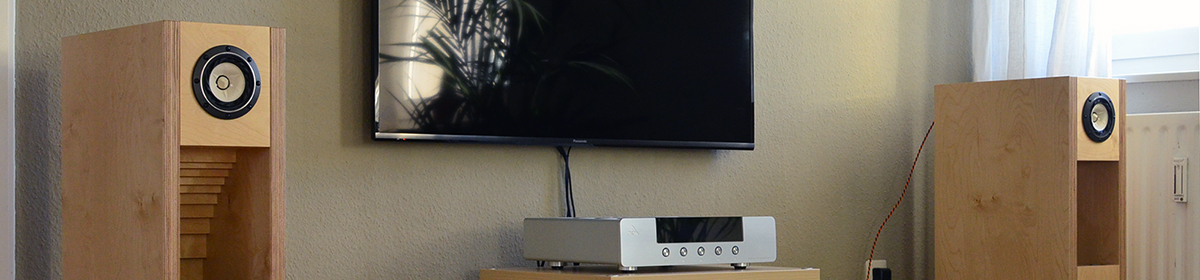

I got to know Volker Heinze through his blog, Truefi, which is a true oasis for those fascinated by vintage audio equipment made in Britain. His expert knowledge in the realm of Tannoy speakers, and especially the 15-inch Dual Concentric Alnico versions from the 1950s and 1960s, is simply astonishing.
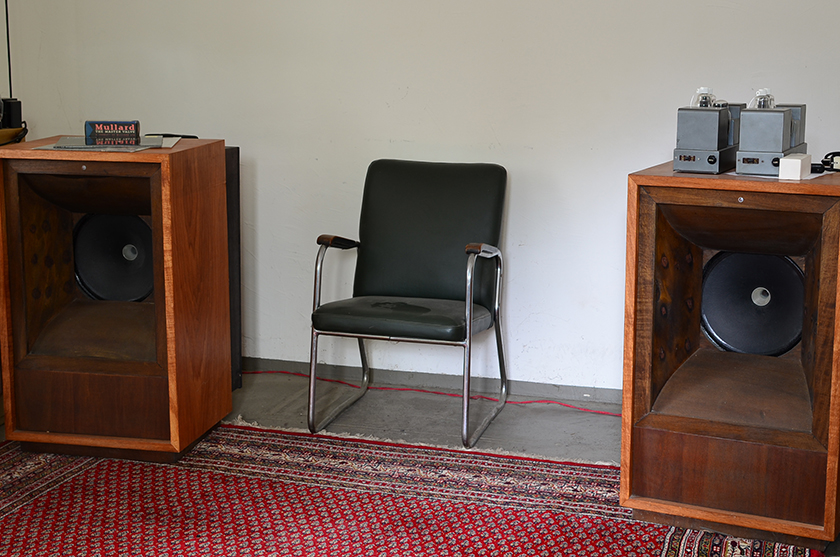
His firm belief in the qualities of these speakers pushed him further to explore new enclosures that he develops himself, based on a combination of Tannoy’s front-loading construction and dipole operation, where the rear part acts like a traditional open chamber. Add to this an extra dose of vintage amplification with the legendary KT66 output tube in an early push-pull design inside the Leak TL12.1 monoblock power amplifier, and you arrive at quite an explosive mixture that could easily ignite one’s imagination.
My desire to listen to his system had grown so strong that I decided to contact him and ask for an opportunity. The correspondence that followed turned out to be nothing but a joy, bringing a lot of funny moments.
First, I had to clear out his suspicion that I was one of those guys whose criteria are formed by contemporary high-end standards and who would therefore be unable to appreciate the virtues of a true fidelity system like his Tannoy setup or the aforementioned Western Electric.
His next step was to make me aware that I would have a rare opportunity in my life and that I should concentrate and absorb everything I could from this session. All this preheating culminated at the moment when I suggested bringing my Belden 8402 interconnect cables so that we could eventually test them in his system.
His answer was so witty that I couldn’t stop laughing for a while:
Any connecting cables don’t play any role in my audiolife anymore. As do analog-to-digital conversion components. You will see, we are going far beyond such questions…
Volker Heinze
Playing his cards like this, he managed to raise my expectations to a point where uncertainty and exaltation met in a dangerous feeling of suspense, exceeding my imagination and previous experience.
It was a radical approach, and very different from what I consider a rational one. Usually, when I first introduce myself, I try to point out my weaknesses and deficiencies so that the disappointment that inevitably follows is not as disastrous. I realized we were very different, but I did not realize how different our ideas about how audio reproduction should sound actually were.
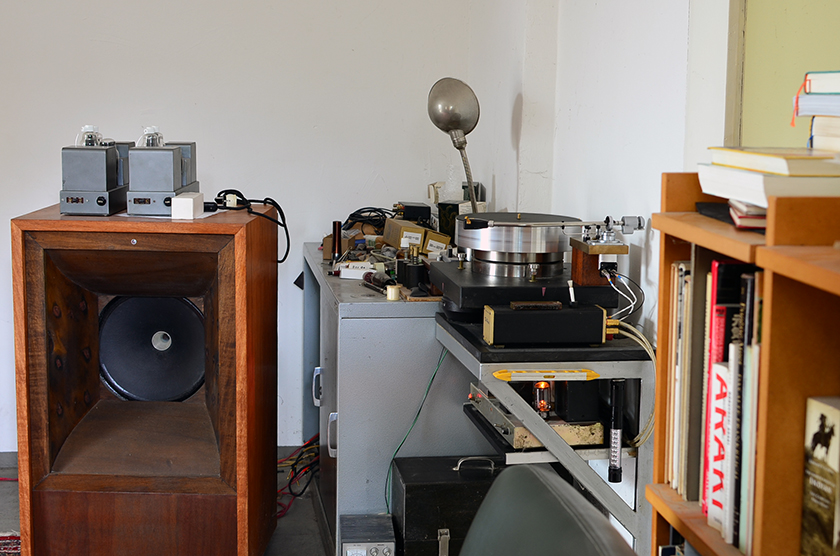
With the first few tones coming out of the Tannoy’s front-loaded dipole enclosures, I realized that what I heard was not my cup of tea. We listened to a variety of Volker’s digitally stored music, with an emphasis on contemporary jazz, as well as some first-pressing vinyl records by Miles Davis, Nina Simone, and Billie Holiday.
There was too much detail, which made the presentation sound too analytical for my taste. But Volker likes it this way, and I cannot blame him — it is his personal preference, and I can understand that. I told him that I found them too forward-sounding and that I felt as if I were standing one meter away from the instruments. In reality, it is never like this. Even if you sit in the first row, which I always try to avoid, you cannot hear such a level of separation and detail. The listening distance was so short that I had the feeling the sounds did not blend together.
At the same time, being open at the back, the bass did not have the means to develop and bloom into its full glory. It was detailed but lacked weight and energy.
I always put a lot of attention on the perception of weight, which is a very interesting phenomenon that contributes greatly to the realism of a presentation. The structure of sound can provide information about the physical dimensions of the instruments being played, and this is something I missed with these speakers, particularly in their reproduction of the lower registers.
Compare it to a heavy cabinet that channels the back-wave energy of the speaker cone and develops it to its full potential, and you will understand what I mean. A pluck of a bass string, a keystroke in the lower registers of a piano, or the impact of a drum should, apart from detail resolution, create a feeling of raw physical mass.
I do not know whether this is caused by specific characteristics in the harmonic structure, but I have the feeling that it is related to the resonant behavior of the enclosure. Usually, resonance-controlled enclosures, together with proper coupling to the floor, are key factors in achieving extended low-frequency reproduction.
Even if the soundstage is compact and positioned only between the speakers, when the feeling of weight is present, the realism is far greater.
Volker considers the phantom stereo image — the virtual stage being projected — and its qualities to be non-essential, as part of the so-called Hi-Fi discourse. For him, the purity of tones and their resolution are what count in terms of true fidelity.
For me, however, it is a matter of integrity whether the voices of the instruments are woven into a consistent stereo projection, where their positions in space can be localized, rather than being scattered randomly. I think this kind of integrity contributes greatly to the believability of reproduction.
I suggested moving the speakers closer to the wall, and when we placed them around 30 centimeters away from it, I very much liked the effect this had on the imaging properties of the system. The stage became smaller, but by moving a few meters back, the presentation became much more integrated and coherent.
The instruments seemed to find their proper places, and with the increased listening distance, the entire experience became much more relaxed and musical instead of analytical and forward-sounding. Of course, some detail was lost, partly due to the lack of proper room treatment, but I liked it much better than before.
Volker told me that, for him, this was not the way to go and that he would rather prefer the original positioning. Once again, this confirmed how different our personal attitudes are and how difficult it can be to find common ground when judging the qualities of sound reproduction.
I still think that my search for the right balance between tonal and sonic characteristics provides better access to the musical content, making the reproduction more persuasive even for people who have never been interested in Hi-Fi. Maintaining balance and avoiding drifting into one particular direction is the path I try to follow — and the one that brings me closer to the music.
There is nothing wrong with this. We are individuals, and we perceive things differently, so there is no objective truth here. Such differences in opinion, however, can become problematic when one searches for confirmation of one’s own ideas about reproduction among other listeners. It can sometimes hurt when it concerns a system of one’s own.
I remember experiencing this myself, but I would always prefer an honest opinion based on valid arguments. Even if it causes some discomfort in the beginning, it can be very constructive in the end.
It could also be that one reason for the discrepancy between our judgments might be a purely biological fact. Volker is one generation older than me, and as you probably know, it is common for hearing sensitivity in the high-frequency spectrum to decrease with age. This could eventually explain why something that sounded harsh to me might sound mellow to someone else.
Whatever my opinion of Volker’s system may be, my impression of him as a person is rather positive. His openness and hospitality contributed to my comfort in a way I have rarely experienced before. We had very nice conversations on different topics concerning audio reproduction and the restoration of vintage equipment, which brought some very interesting insights to my attention.
We compared different LP releases of one of the most important jazz albums of the 20th century — Miles Davis – Kind of Blue — commonly regarded as one of the first major examples of modal jazz. It was a valuable experience, and I am very thankful for it.
Thank you for stopping by!
“kind of Blue” – commonly known as the very first initial piece of modal music in the jazz history”
A small amount of research would be helpful. Miles Davis ‘milestones’ would be an earlier piece of modal jazz. Cannonball Adderly and Coltrane much earlier.
Hi John,
Cannonball Adderley and John Coltrane participate themselves in the recording of “Kind of Blue” as members of Miles Davis’s sextet and integral part of the modal jazz development, so I don’t see them as predecessors. John Coltrane’s explorations into the modal improvisation have their bloom in the 1960’s while recording with his classic quartet. “Kind of Blue” is based entirely on modality, in contrast to “Milestones” which is considered only as a starting point of the modal experiment.
Your visit was very good to see/hear for your self what others vision on quality reproduction is.
We become often very impressed to longlasting storys on someones private page to good to be true, simply put :you can only trust your own ears.
I have Tannoys too, 15″ Golds, and i think Tannoy did very well to introduce a transformer for the high frequency output, especially when you remove the dustcap (like i did by simply heating the dustcap glue with my soldering iron) or do not use the dustcap like Volker do
Whithout dustcap the high frequencys are much more pure or say true, but they become to hot when not reducing the HF-output.
In fact i think that his attempt to design his own enclosure is a very good choice when you compare them to (most of) the Tannoy cabinets of the 60s and 70s.
So i think he is an onnest man in vintage audio but always be aware of the fact that your preferences can differ.
Thank you very much for your kind words and insights regarding the 15-inch Tannoy Dual Concentric speaker Bram! To be honest I didn’t even noticed that the dust cap of the HF horn have been removed, but as you said I found the high frequencies pretty hot 🙂 Volker is definitely an honest man and I enjoyed my visit in spite of the fact that the sound in his listening room was not what I expected.
I have just find his, and your blog yesterday.
Exciting, thanks.
About my comment on other section about your tv, I have see your curtain…and your accosutic work with “diffusers”, i suggest to you to put your heavy bath-towel on your TV and keept your curtain open 😉
Thanks Marc, I appreciate your kind words!
I shall have to check your suggestion regarding the bath towel. I do remember playing with some blanket before I decided to put curtains, but I was not very satisfied due to aesthetic reasons. With the curtains being not very thick, the wall have mixed diffusive/absorptive qualities and works pretty well. But it is never a bad idea to revisit different aspects of the setup from time to time.