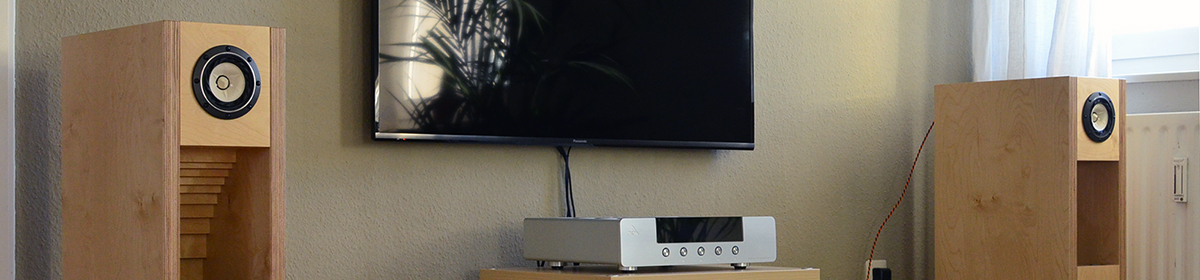
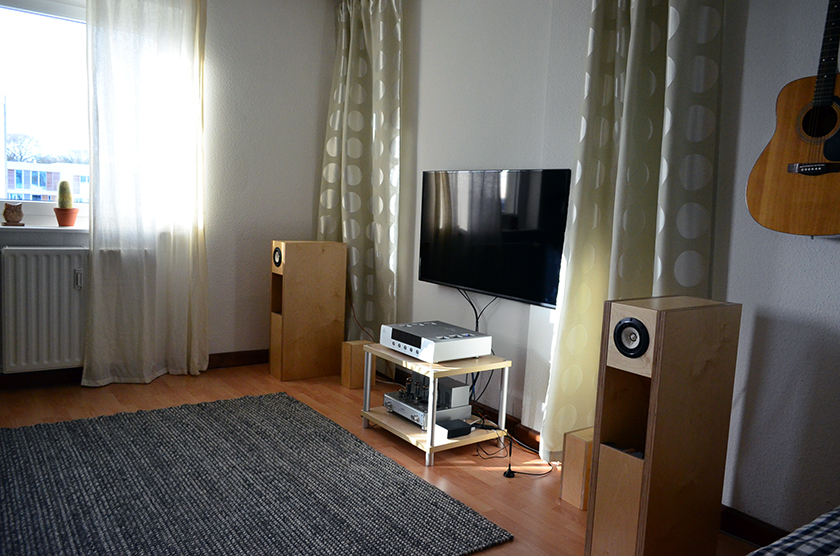
Speakers are the most important component in an audio chain. I can’t remember any other component that has influenced my home audio system as much as my speakers have. Speakers disperse sound waves throughout the room, interacting with its boundaries, and one shouldn’t think about them separately but rather in conjunction with the particular room.
It is a well-known fact that a room’s acoustic properties and dimensions place certain requirements on speakers. There is also a relationship between room and speaker size that needs to be considered, and one of the most common mistakes one can make is choosing speakers that are far too big for a given room.
The other important thing about speakers is that their fine-tuning and adjustment can bring as substantial an improvement to the sound as the tuning of no other component can. Positioning alone—involving the adjustment of the distance between the speakers, between the speakers and the back wall, between the speakers and the listener, and finally the toe-in angle—can improve the overall performance of the system manyfold.
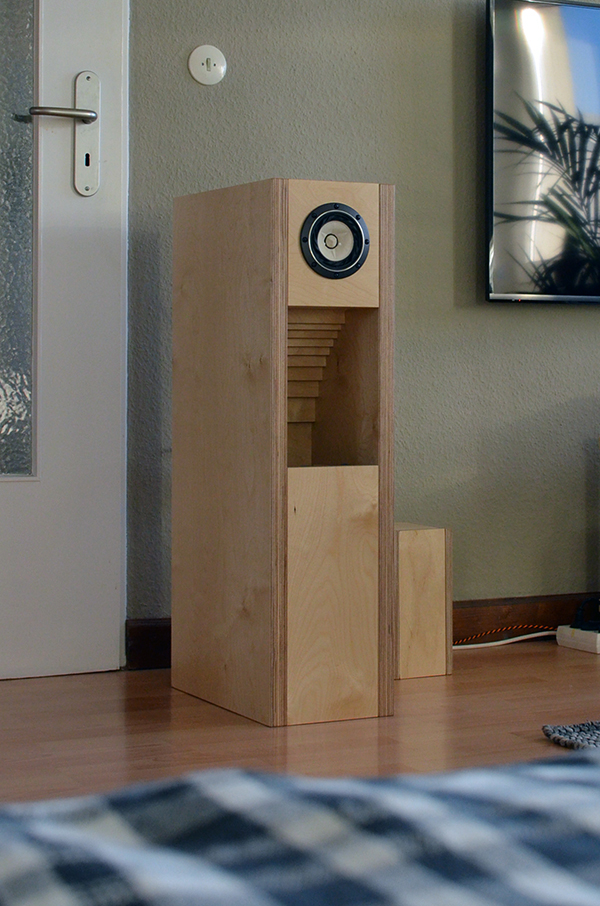
By choosing an appropriate speaker cable and tuning the crossovers or notch filters, one can achieve dramatic improvements. Some types of speakers, such as my Fostex BK108 back-loaded horns, additionally allow adjustment of the damping material, both in the compression chamber and inside the horn mouth, which provides virtually endless possibilities for fine tonal balance adjustments.
The aforementioned tuning possibilities ultimately affect the room’s frequency response, which should be as flat as possible. One should also remember that even a small component change in the system, such as an interconnect cable, may require the speakers to be readjusted.
How I got into full-range horn speakers
Before I got into full-range horn speakers, I owned several two- and three-way bass-reflex speakers. The problem I had with them was that the sound they delivered was not very convincing in terms of realistically portraying the fundamental aspects of music, such as timbre and tone colour, but also non-musical attributes like transparency, soundstage, and imaging. They never managed to disappear completely, and the illusion of the sound coming from the musicians’ instruments positioned on the imaginary soundstage between them never occurred.
It was in a small hi-fi shop in Hamburg that I first stumbled upon a pair of full-range back-loaded horn speakers. I first listened to a few relatively large bass-reflex speakers, and they made quite an impression on me with their deep bass and crisp highs. Towards the end of the session, I noticed a pair of small, rather unusual-looking speakers sitting quietly in the corner behind all the others. Each of them had only a single driver, one of the smallest full-range drivers produced by the Japanese manufacturer Fostex—the FE103. I asked if I could listen to them, and the salesman tried to persuade me not to because they did not produce much bass and he thought I would probably be disappointed. But I insisted, explaining that a realistic and convincing presentation was what I was looking for rather than deep bass. He connected them to the amplifier and put on some female vocal jazz—if I remember correctly, it was Diana Krall.
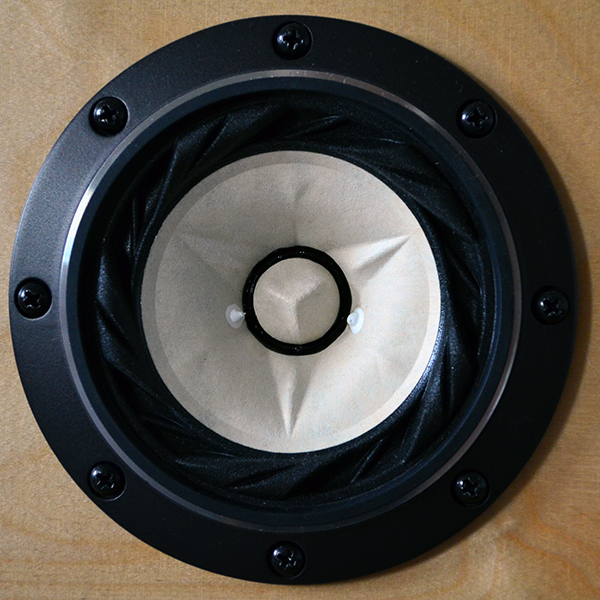
Listening to these small Fostex horns came as quite a revelation. After listening exclusively to box speakers, I suddenly realised how coloured they sounded. The horns stripped away the boxy colouration, replacing it with a wonderfully organic sound. Being single-driver speakers, they have no crossover. This means there is no need to split the signal between multiple drivers and, consequently, no phase shifts caused by the crossover components. Although the bass was neither particularly deep nor extended, it was fast and clear. At that very moment, I knew what type of speakers I would be looking for.
The problem was that such horn speakers are not easy to find in hi-fi shops. They are very popular in Japan, but here in Europe one has to build them oneself or find a specialised woodworker to do it. Usually, the manufacturer of the full-range driver—in my case Fostex—provides plans for a dedicated enclosure free of charge, so anyone interested in a particular loudspeaker design can buy the driver and build the enclosure themselves.
I had neither a workshop nor the required woodworking skills, so I needed to find a solution. I started researching DIY resources on the internet and bought an issue of Hobby HiFi magazine. In its pages I came across a manufacturer called Art of Sound, based in Saarbrücken, Germany, which specialises in horn loudspeaker construction. I contacted Günter Damde, the owner of the company, and promptly ordered a pair of Fostex BK108 back-loaded horn loudspeakers. I waited nearly two months for the speakers to be completed, but ever since then I have enjoyed the organic flow of music as never before.
Thank you for stopping by!
That’s a fantastic story and how you came into the full range driver camp. The first commercial full range driver speakers were the moth audio cicada speakers. I have had many drivers before that full range but, I asked the sales guy at the HiFi shop if I could listen to them. I fell in love with the very real micro detailed moth audio speakers. The highs and mid-range was really one of a kind. The bass was to be desired but was there. Never bought a pair. The company went out of business. So a few years later I bought a pair of the fostex Fe 108 sigma drivers used. They sounded great. My favorites were the fe126en drivers and I did a ( A&B) test between the two drivers. The fe126en had a little more bass and the mid-range was good and the highs rolled off. The fe108sigmas drivers beat the fe126en drivers in all areas. The thing I noticed the most was the clearly in voices and top end. The bass was a plumb and well it’s a 4 inch driver. I have never heard then in a horn box just a transmission line. Well thanks for the write up. I might have to get me a pair of drivers and build this box? Cheers Jm
Hey Jm,
Thanks for the nice feedback and sharing your experiences with single-driver speakers! I think a back-loaded horn can deliver even more drama than transmission line, but it depends on the particular design and the construction quality of course.
Cheers,
Dimitar
Yes I agree a back loaded horn is ones of the best boxes your you can have. Transmission lines never sound right to me in the bass department. Like it added a extra db’s to it. The only Transmission line I like and the only one was meadowlark audio the shearwater speakers.. The hot rod version.. Well thanks for commenting on my post.. Cheers Jeff